
Short answer: to avoid buying a lemon in Australia, check the listing, the service history and the model's known problems before you go, run a $2 PPSR search on the VIN, inspect the car cold and in daylight, test drive it for at least 15 minutes, and match the VIN and the paperwork before you pay. Always ask the seller if a mechanic can inspect it, then decide whether this car needs one.
Most "used car checklists" are a list of 80 things to look at with no idea which ones matter. This one is in the order you'll actually do it: from the couch, at the car, on the road, and at the moment you hand over money. Each step tells you what a bad sign looks like and what to do about it.
What does "lemon" mean in Australia?
A lemon is a car with a serious fault that keeps coming back or costs more to fix than you planned for. Australia has no specific "lemon law" for used cars. What protects you depends on who you buy from:
| Private seller | Licensed dealer | |
|---|---|---|
| Consumer guarantees (Australian Consumer Law) | Mostly no. The seller must have the right to sell it (clear title), and that's about it. | Yes |
| Statutory dealer warranty | No | Usually yes on younger, lower-km cars. In NSW: under 10 years and under 160,000 km, 3 months or 5,000 km, whichever comes first. Rules differ by state. |
| Cooling-off period | No | Sometimes. Only in some states and situations (e.g. NSW: one business day when the dealer arranges your finance). |
| Typical price | Lower | Higher |
In short (see the ACCC and the NSW rules on dealer guarantees): buying privately on Facebook Marketplace or Gumtree is cheaper, but if the gearbox dies a week later, it's your problem. The checks below matter most for private sales.
Step 1Before you go, check the listing (from the couch)
You can rule out most bad cars without leaving the house.
Read the listing like a detective
- Kilometres vs age. Compare with similar cars of the same year. Far fewer kilometres can be a gem, or a wound-back odometer. The service history is how you tell (next section).
- "Full service history" in the ad means nothing until you've seen it.
- Vague phrases: "just needs a re-gas", "minor issue", "selling as is", "no time to deal with it". Ask exactly what the issue is.
- Price well below similar cars. Either there's a problem or it's a scam (see below).
- Photos only from one side, wet, or at night. Ask for more.
Check the service history (properly)
Everyone says "ask for the logbook". Here's what you're actually looking for.
Before you go, ask for photos of:
- the last two or three services in the logbook (stamp, date, kilometres);
- the invoices for the big jobs the seller mentions or that are due at this age: timing belt, gearbox service, clutch, brakes, tyres.
Few sellers will photograph the whole book, and you don't need them to. The recent pages and the big invoices are what matter. A seller who won't send even those is telling you something.
What to check in the photos, and again in person:
- Kilometres only go up, and roughly in line with the service interval (every 10,000 or 15,000 km, or once a year). A big gap isn't proof of anything, but ask what happened.
- The last stamp vs the odometer today. If the last service was at 120,000 km two years ago and the car now shows 125,000, either it barely moved or the numbers don't add up.
- Real workshops. Stamps should have a business name, and ideally an address or ABN. Google the workshop. If you have doubts, call them: many will confirm whether a car was serviced there on a given date.
- Same pen, same day. A whole book filled in with the same pen and handwriting, or stamps that all look brand new, is a sign it was filled in at once.
- Digital records. Many brands now keep service records online. A dealer of that brand can often look up the car's history by VIN.
At the car, cross-check the kilometres against everything else that records them: the logbook, the invoices, the oil change sticker on the windscreen or door jamb, and any old roadworthy or pink slip. They should all tell the same story. Then compare with the wear: a driver's seat, steering wheel and pedals worn smooth on a car showing 60,000 km don't add up.
Look up the model's known problems
This is the step most buyers skip, and it's the one NSW Fair Trading puts first in its own buying advice: look online for feedback on that make and model and ask a mechanic if they know of problems. A 2012 car with a known automatic gearbox issue at 150,000 km is a very different purchase from one with a bulletproof engine.
Ask yourself: which expensive parts usually fail on this model at this age and kilometres, and has the seller already replaced them? That's the question that decides whether a cheap car stays cheap.
The problem is time. Doing this properly means forum threads, owner reviews and service intervals for every car on your shortlist, and you're usually comparing five or six different models at once.
Get the plate and VIN before you drive anywhere
If the seller won't give you the number plate and the VIN, move on.
Free rego check. Every state has one on its transport website. It shows whether the car is registered, when the rego expires, and whether the make and model match the listing. In most states the number plate is enough; some also accept the VIN.
| State | Where | Search by |
|---|---|---|
| NSW | Service NSW, check a vehicle registration | plate, or VIN for cars built from 1989 |
| VIC | Service Victoria, check registration | plate or VIN |
| QLD | Queensland Government, check registration status | plate, or VIN for cars built after 1989 |
| WA | Department of Transport WA | plate |
| SA | EzyReg | plate or VIN |
| ACT | Access Canberra | plate |
| TAS | Transport Tasmania | plate |
| NT | the NT Motor Vehicle Registry website | plate |
The VIN you need for the PPSR search (next section): the PPSR doesn't search by number plate.
Is the car registered in another state?
If the car is registered in a different state from the one you'll register it in, you're doing an interstate transfer, and the rules of your state apply. A car that's perfectly legal in its home state may need a new inspection before you can register it in yours.
Example: we bought a VW Caddy van in NSW and later sold it to a buyer in Victoria. He had to get a Victorian Certificate of Roadworthiness to register it there: a NSW pink slip doesn't count in Victoria.
Before you agree on a price for an interstate car, check what your state's transport authority needs to register a vehicle from another state (VicRoads, for example) and budget for the inspection and any repairs it finds.
Watch for scams (and check the seller)
The classic signs:
- the seller is "overseas", "on deployment" or "moving interstate" and wants a deposit before you see the car;
- pressure to pay a deposit by bank transfer or gift card to "hold" it;
- a price far below market on a popular model.
Five minutes on the seller's profile catches most of the rest:
- How old is the account? On Facebook, a profile created a few weeks ago with no friends is a warning sign.
- Does it look like a real person? Other photos, posts over the years, friends, a town. Check their Marketplace ratings and what else they're selling: five cars at once is a dealer pretending to be a private seller.
- Reverse-search the photos. Open the profile picture and the car photos and search them on Google Images (or Google Lens, or TinEye). If the same photos show up on another listing, in another city, or under another name, walk away.
- Does the name match? The name on the profile should match the name on the registration papers when you see the car.
Never pay anything for a car you haven't seen in person, with the seller, at an address you can verify. See Scamwatch for current scams.
Step 2Run a PPSR check ($2)
The Personal Property Securities Register is the government register. A search costs $2 online and uses the VIN (not the number plate). It tells you:
- whether money is owed on the car (a security interest, usually finance). If you buy a car with finance owing, it can be repossessed even though you paid for it;
- whether it's recorded as stolen;
- whether it's recorded as written-off.
What a PPSR check doesn't tell you: the service history, whether the odometer is genuine, or every accident the car has had. A car can have been crashed and repaired without ever being recorded as written off. A clean PPSR means "no money owing, not recorded as stolen or written off". It doesn't mean "good car".
How to read a PPSR certificate
The certificate isn't written for normal people. Here's a real one (from that Caddy, personal details hidden) with the four parts that matter:
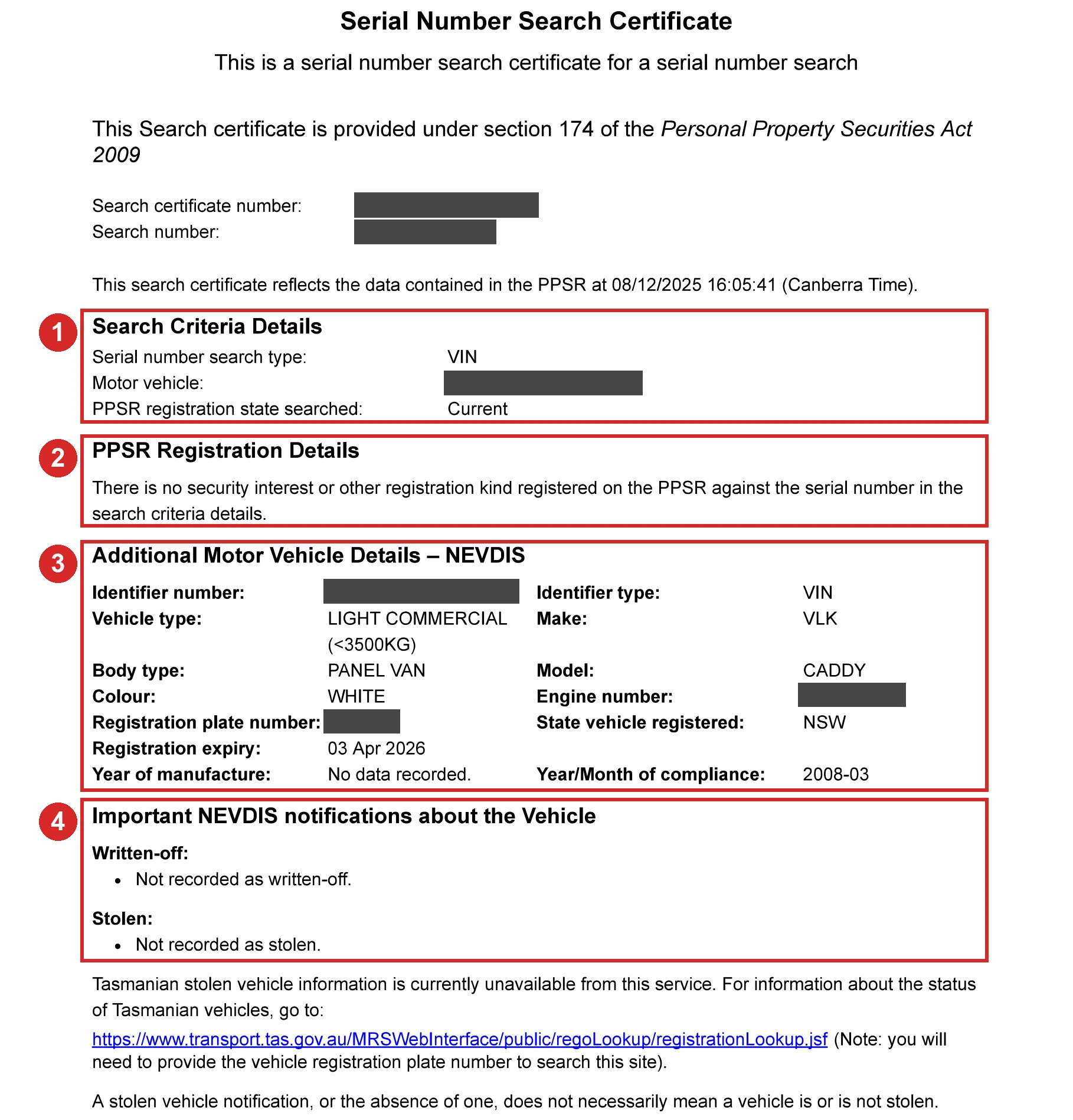
- Search Criteria Details. The VIN you searched. Check it character by character against the VIN on the car: a PPSR on the wrong VIN tells you nothing about this car.
- PPSR Registration Details. This is the finance part. A clean one says exactly: "There is no security interest or other registration kind registered on the PPSR against the serial number in the search criteria details." If instead you see a security interest listed, money is owed on the car: the seller must pay it out before you hand over money, and you want the lender's payout letter in writing.
- Additional Motor Vehicle Details. What the state registries know about the car: make, model, body, colour, plate, state, rego expiry, compliance date. All of it must match the car in front of you. Two things that look odd but are normal: the make is often a short code (VLK is Volkswagen, for example), and older cars often show "No data recorded" for the year of manufacture.
- Important notifications. You want "Not recorded as written-off" and "Not recorded as stolen". If it's recorded as written-off, check whether it's a repairable write-off (can be repaired, inspected and re-registered) or a statutory write-off (can never be registered again). Note the small print: stolen-vehicle data isn't available for Tasmanian cars, and the certificate itself says a missing notification doesn't prove a car isn't stolen.
When to run it: once, as close to buying as possible, because finance can be registered against a car at any time. In practice: on the day you go to see the car (you'll often buy on the spot), or the day before you pay.
Step 3Inspect the car yourself (30 minutes)
Rules before you start:
- See it in daylight, and dry. Rain and darkness hide dents, paint differences and leaks.
- Ask the seller not to start the car before you arrive. You want to hear a cold start (Step 4).
- Bring: a torch, a soft fridge magnet, paper towel, a friend.
NSW Fair Trading has a good way of putting it: most buyers can spot defects easily, they just spot them at home after they've paid. So go through the car as if you'd already bought it and were trying every function.
Outside: has it been crashed?
- Panel gaps. Look where the bonnet, doors and boot meet the body. Compare one side with the other: gaps that are uneven or different side to side can mean an accident repair.
- Paint. Colour differences between panels, ripples when you look along the side against the light, and overspray (paint on rubber seals, plastic trim or glass) all point to a respray.
- Body filler. A soft fridge magnet won't stick where there's plastic filler.
- Hail. Look along the bonnet, roof and boot lid. Hail damage makes a car harder to insure.
- Doors and boot should close firmly and lock. Check the rubber seals.
Rust
Check wheel arches, sills under the doors, the bottom of the doors and the boot floor (lift the mat). Surface rust on a bolt or an exhaust is normal on an older car. Bubbling paint, holes, or rust on the sills and chassis rails is a different story: that can be structural, expensive, and a roadworthy problem. If you're unsure, that's a job for the mechanic.
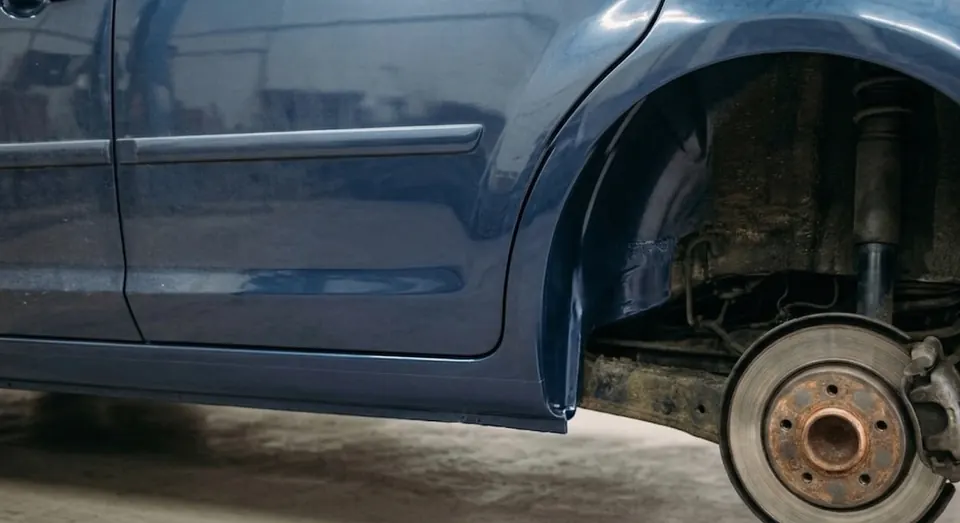 OK
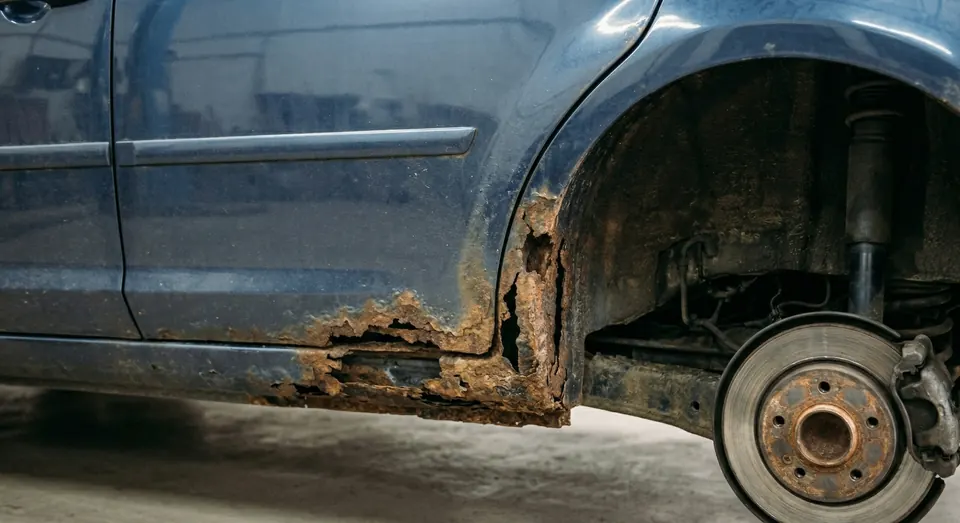 Walk away
Water inside (and flood cars)
- Lift the floor mats and look in the spare wheel well for water, rust or mud.
- A musty smell, new carpet in an old car, rust on seat bolts or pedal screws, or a water line inside the headlights are signs of a flood-damaged car. Flood-damaged cars do get cleaned up and resold after big floods. Walk away.
Tyres
- Check tread depth on all four and the spare. NSW Fair Trading suggests at least 5 mm; the legal minimum is lower.
- Uneven wear (bald on the inside edge, fine on the outside) points to alignment or suspension problems.
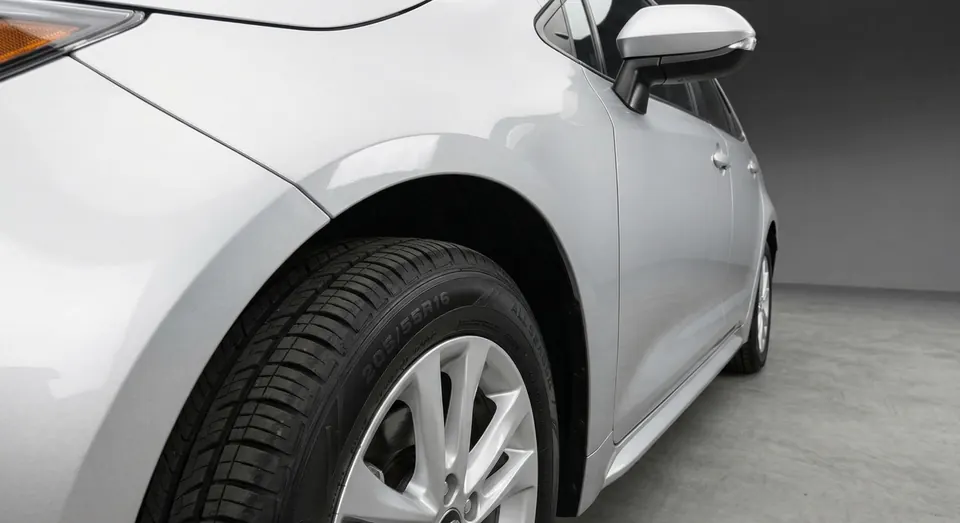 OK
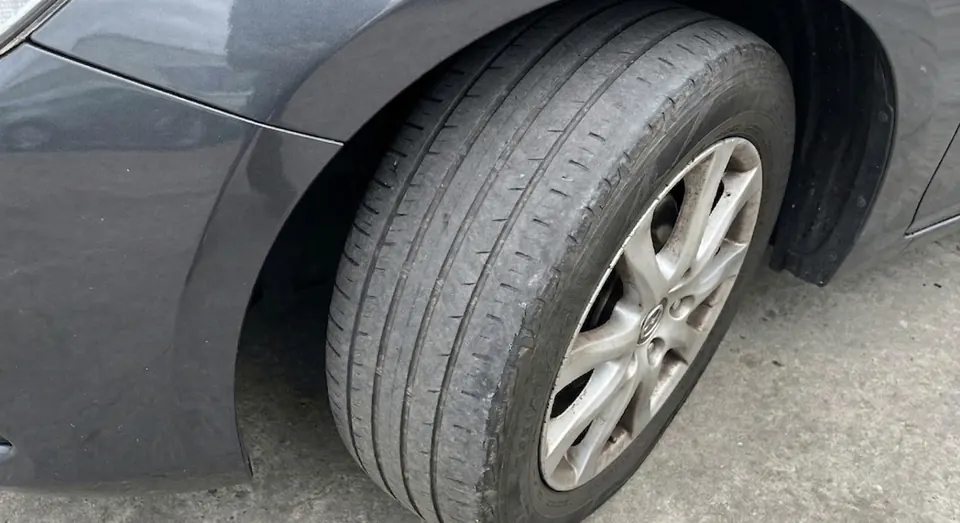 Check alignment
Under the bonnet (engine off and cold)
- Oil (dipstick and oil cap): dark and thick suggests poor maintenance. Grey or milky oil, or a creamy beige residue under the oil cap, can mean coolant or water in the oil, which is serious.
- Coolant: only open the tank with the engine cold. It should be clean and brightly coloured. Brown sludge or an oily film can mean oil is mixing in, often a head gasket problem.
- Leaks: shine your phone torch along the valve cover (the top of the engine) and underneath it. Fresh, wet oil means an active leak; check the ground under the car too.
- Radiator fins corroded or damaged.
- Timing belt: if the engine has a belt (not a chain), look for a sticker or invoice showing when it was last changed. If the car is past the change interval with no proof, budget for it: on many cars it's a job of several hundred dollars or more. Check the interval for that engine. If part of the belt is visible, also look at its condition: cracks, frayed edges, missing teeth or oil on it mean it's due whatever the sticker says.
- Accessory belt (the ribbed belt at the front of the engine): cracks, fraying or missing chunks mean it needs replacing.
- A freshly pressure-washed engine proves nothing, and can hide leaks.
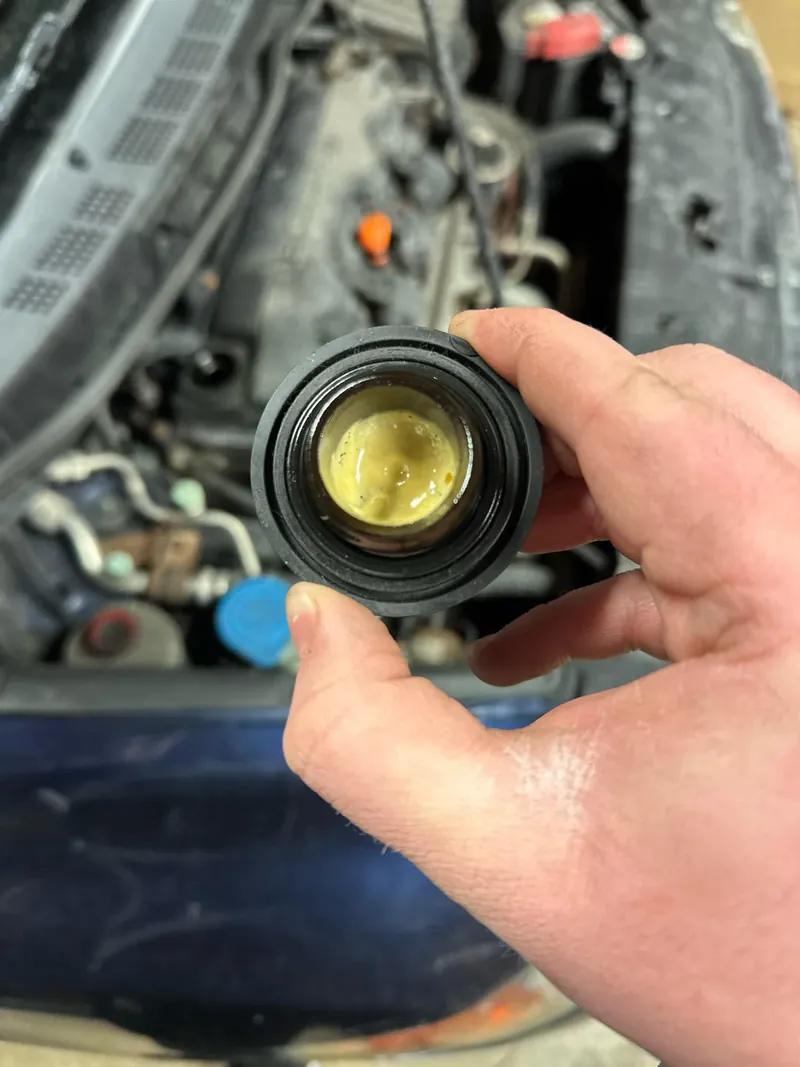
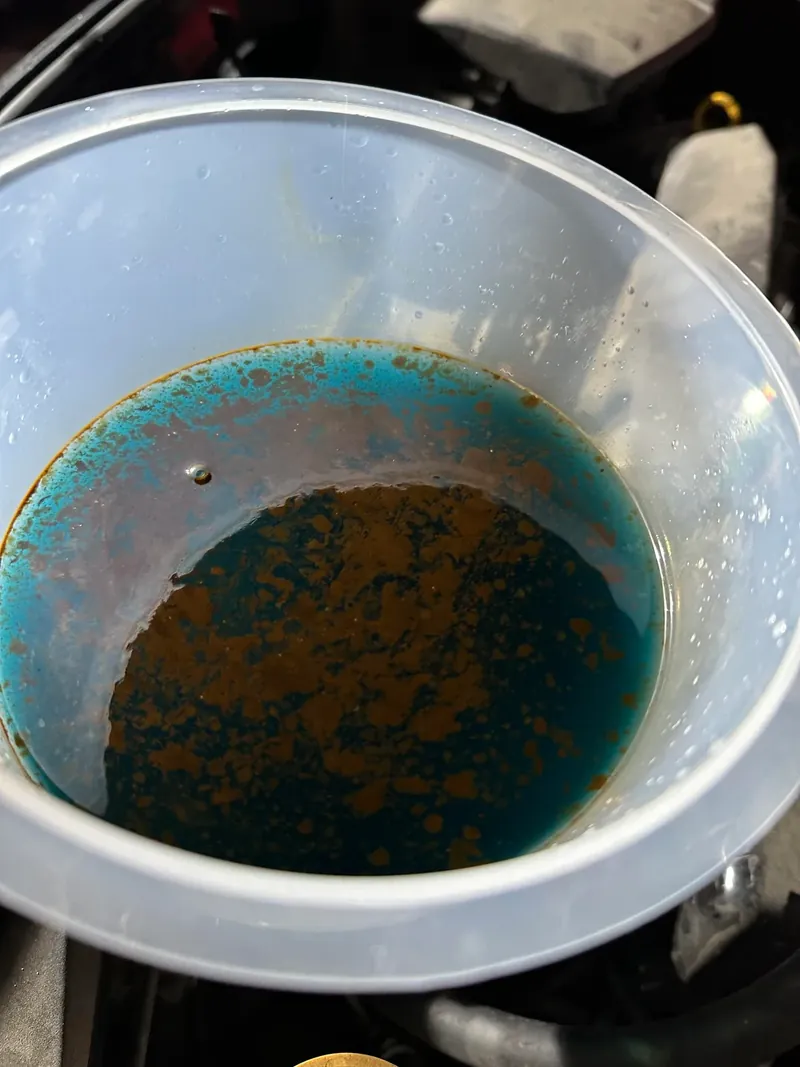
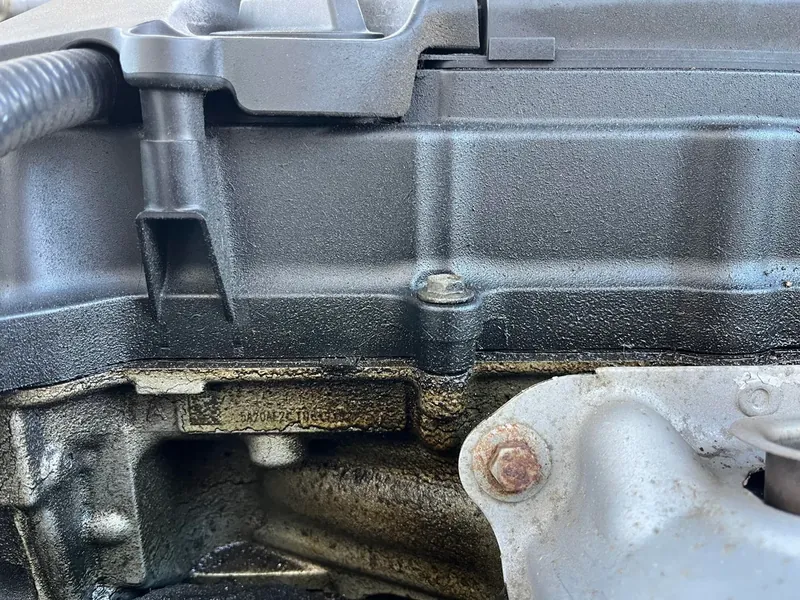
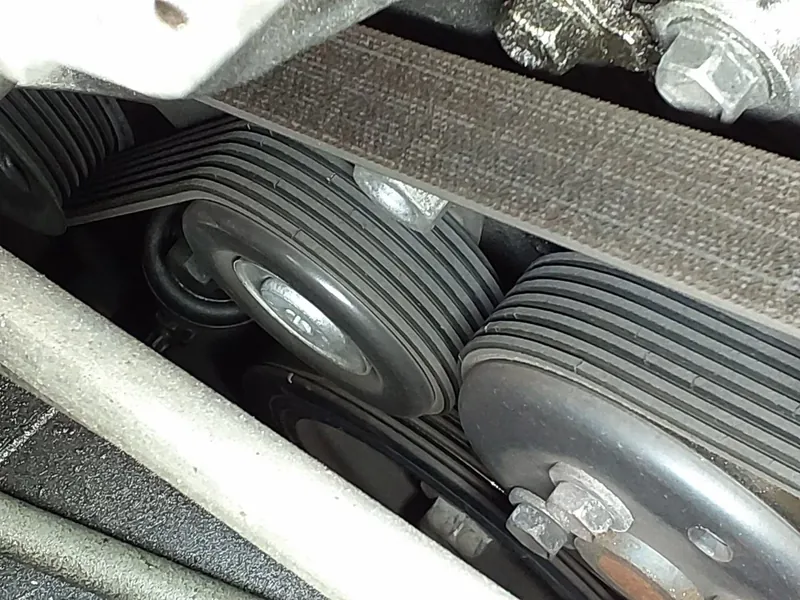
Real photos shared by car owners on Reddit. Tap a photo to enlarge.
Inside
- Warning lights: with the key on (engine off), the dash lights should come on, including ABS and airbag. When the engine starts they should go off. An engine or airbag light that stays on needs an explanation and a diagnosis before you buy.
- Test everything: air con (should be properly cold, not "just needs a re-gas"), windows, central locking, fan, stereo, horn, wipers, lights.
- Seat belts retract on their own and aren't frayed.
- Wear vs kilometres. A driver's seat, steering wheel and pedals that are heavily worn on a car claiming 60,000 km don't add up. It's not proof of anything, but it's a reason to check the logbook and odometer history carefully.
- Spare, jack and tools present.
Identity of the car
- The VIN must match on the car (base of the windscreen, door pillar), on the registration papers and on your PPSR result. Scratches, grind marks or drill holes around the VIN or engine number can mean the car is stolen or "rebirthed". Walk away.
- Build and compliance plates. Cars built from 2021 may not have them: their data is on the Register of Approved Vehicles (RAV), which you can search by VIN.
Step 4The test drive (at least 15 minutes)
First, ask the seller whether their insurance covers you while you drive.
- Cold start. The engine should start easily and idle smoothly. Watch the exhaust: blue smoke = burning oil; thick white smoke that doesn't clear = possible coolant problem; black smoke = running rich.
- Mix of roads: stop-start traffic, a hill, and a stretch at 80–100 km/h.
- Gearbox: shifts should be smooth with no clunks, slipping or flaring revs. On front-wheel or all-wheel drive, clicking on full lock can mean worn CV joints.
- Brakes: the car should stop straight. The pedal shouldn't feel spongy or sink. A steering wheel that shakes under braking usually means the discs need attention.
- Steering: the car should track straight without you correcting it.
- Suspension: turn the radio off and listen for clunks over speed bumps.
- Temperature gauge stays in the normal range the whole time.
- Diesels: a modern diesel should pull cleanly through the rev range. Losing power with a warning light can be a DPF or sensor issue that needs a proper diagnosis. Be wary if the seller asks you not to rev it.
Anything odd on the test drive isn't a diagnosis. It's a question for the seller and for the mechanic.
Step 5Decide whether to get a pre-purchase inspection
A licensed mechanic or an inspection service puts the car on a hoist, scans for fault codes and checks what you can't. It usually costs a couple of hundred dollars or more. Whether it's worth it is a cost-benefit call, not a rule.
It's usually worth it when:
- the car is expensive, complex (European, turbo, dual-clutch, 4WD) or has high kilometres;
- the service history has gaps, or you can't verify it;
- something in your own checks or the test drive didn't feel right;
- the model has a known expensive weak spot and you can't tell whether it's been fixed.
It may not be when it's a cheap, simple, famously reliable car with verified history, and everything you checked was clean. Spending $300 to inspect a $3,000 Corolla that passed every check buys you only a little extra certainty.
The hidden cost is time. Booking an inspection takes a day or two, and good cars at good prices don't wait. That's exactly how I lost a great Toyota Corolla in Australia: I was waiting for the mechanic, and someone else bought it first. The car was fine.
Always ask whether you can have it inspected, even if you're not sure you'll book one. An honest seller has no reason to say no, so a refusal is a red flag on its own. If they say yes, everything checks out and the seller seems straight, you can then decide the inspection isn't worth the time.
If you do want one, keep it fast: use a mobile inspector who comes to the car, and book it the same day you decide.
Step 6Paperwork and paying
- Service history: flip through the whole logbook now, not just the pages you saw in photos, and take the invoices for the big jobs with you.
- Odometer: write down the reading at handover. It goes on the receipt.
- Roadworthy / safety certificate: whether the seller must provide one depends on the state. In Victoria you need a Certificate of Roadworthiness to transfer the registration; in Queensland a seller must have a current safety certificate for a registered car. Check your state's transport website.
- PPSR done on the day you saw the car or the day before: if it's older than that, run it now.
- Complete the transfer with your state's transport authority within the deadline (in NSW, 14 days).
- Pay safely: in person, ideally by bank transfer when you collect the car and the papers. Not cash in a car park, not a deposit to a stranger.
- Get a receipt signed by both of you. Use the template below.
Receipt template for a private car sale
Copy it, print two copies, fill them in together and both sign both. One for you, one for the seller.
RECEIPT OF SALE / DEPOSIT
SELLER
Name: ___________________________
Address: ________________________
Licence no.: ____________________
Date of birth: ____/____/________
I certify that I am the lawful
owner of the vehicle below, or have
full written authority to act on
behalf of the owner.
VEHICLE
Make: ___________________________
Model: __________________________
Year: ___________________________
Colour: _________________________
Km: _____________________________
Registration no.: _______________
State: __________________________
VIN: ____________________________
Engine no.: _____________________
Sold: [ ] As is
      [ ] With roadworthy / safety
          certificate
Finance owing to: _______________
           (or "none")
Known faults disclosed by seller:
_________________________________
BUYER Name: ___________________________ Address: ________________________ Licence no.: ____________________ Date of birth: ____/____/________
PRICE
Total amount agreed: $___________
Deposit taken:       $___________
Balance owed:        $___________
The buyer agrees to the above
price. Full payment will be made
on collection of the vehicle, sold
as is or with a roadworthy / safety
certificate as ticked above. No
warranty or guarantee is given on
this vehicle or related items, as
it is sold in the private used
market.
Seller's signature: _____________
Date / time: ____________________
Buyer's signature: ______________
Date / time: ____________________
HANDOVER
Date / time: ____________________
Km: _____________________________
Why each part is there:
- Names, addresses, licence numbers and dates of birth identify exactly who sold and who bought. Check the seller's against their actual licence and the registration papers: if they don't match, you may be buying from someone who doesn't own the car.
- The owner's declaration puts in writing that the seller has the right to sell. If it turns out they didn't, this is your evidence.
- VIN, engine number and registration tie the receipt to this exact car, and must match the PPSR and the rego papers.
- Km at the time of the agreement, and again at handover (see below).
- Price, deposit and balance. The price is what the transfer and stamp duty are worked out on: write the real one. If you pay a deposit to hold the car, this receipt is your proof of it.
- Finance owing to puts in writing whether the seller declared the car free of debt, or who they still owe.
- As is vs with a roadworthy / safety certificate. "As is" means you accept the car in its current state and any repairs are yours. In Victoria and Queensland the seller normally has to provide a certificate to transfer a registered car, so if the receipt says "as is" there, ask why. In NSW a registered car is usually sold as is.
- Known faults. Anything the seller told you about. It protects you both: they can't later claim they told you something they didn't, and you can't claim they hid something they disclosed.
- Handover date, time and km. Fines, tolls and accidents before that moment are the seller's; after it, they're yours. And the km shouldn't have moved much since you agreed the sale.
This isn't a lawyer-drafted contract: it's a written record of what you agreed, which is far better than nothing if something goes wrong. Your state's transfer is separate and still has to be done.
Step 7After you buy (the first 14 days)
Paying isn't the last step. The car isn't legally yours on the register until the transfer is done.
- The seller tells the state the car is sold. In NSW this is the notice of disposal, and it's due within 14 days; Victoria has the same, and in Queensland the seller starts the transfer online and you finish it. Ask the seller to do it on the spot, on their phone: in NSW you can only do your part online once they've done theirs.
- You transfer the registration into your name, usually within 14 days of buying, online or at a service centre. You'll need the receipt, your licence and, depending on the state, the roadworthy or safety certificate. Late transfers cost more.
- You pay stamp duty on the price (or the car's value), at the same time as the transfer. The rate depends on the state and the price.
- Insurance. Compulsory third party (CTP) covers injuries to people, not damage to cars. Arrange comprehensive or third party property cover before you drive away.
- Bought it in another state? You'll register it in yours, with your state's inspection (see Step 1).
- Save everything: receipt, PPSR certificate, inspection report, logbook, transfer confirmation.
| State | The seller tells the state | You transfer the rego | Certificate to transfer |
|---|---|---|---|
| NSW | Notice of disposal, within 14 days | Within 14 days; online once the seller has lodged theirs | None for a registered car |
| VIC | Notice of disposal, within 14 days | Within 14 days | Roadworthy certificate |
| QLD | Starts the transfer online, within 14 days | Within 14 days (you finish it online) | Safety certificate, from the seller |
| WA | Within 7 days | Within 14 days, online with DoTDirect | None for a WA-registered car |
| SA | Notice of disposal | Within 14 days, online with mySAGOV | None |
| ACT | Notice of disposal | Within 14 days | Check with Access Canberra |
| NT | Notice of disposal, within 14 days | Within 14 days | Inspection rules changed in 2026: check with the Motor Vehicle Registry |
| TAS | Check with Service Tasmania | Check with Service Tasmania | None for a Tasmanian-registered car |
Interstate cars usually need an inspection before you can register them in your state (Step 1).
The paperwork of owning a car in Australia (and what it costs)
Buying the car is a one-off. Keeping it on the road comes with yearly paperwork that changes from state to state, and it should be part of the price you're willing to pay.
| State | Compulsory injury insurance (CTP) | Yearly inspection | To register an unregistered or interstate car |
|---|---|---|---|
| NSW | Separate: you buy a green slip from an insurer before each renewal | Pink slip (safety check) for most cars over 5 years old | Blue slip inspection |
| VIC | Included in the rego (TAC charge) | None | Roadworthy certificate |
| QLD | Included in the rego, you choose the insurer | None | Safety certificate |
| WA | Included in the licence fee (Motor Injury Insurance) | None | Inspection at an authorised station |
| SA | Included in the rego, you choose the insurer | None | Check with Service SA |
| ACT | Included in the rego, you choose the insurer | Older cars may need one: check with Access Canberra | Inspection |
| NT | Included in the rego | None since February 2026 | Check with the Motor Vehicle Registry |
| TAS | Included in the rego (MAIB) | None | Inspection at an approved station |
Rego itself is usually paid yearly, with shorter periods available in most states. The NSW safety check rules explain when you need a pink or blue slip.
Three things that cost buyers money
1. CTP doesn't cover damage to other cars. This is the one most people find out too late. CTP (the green slip in NSW, included in the rego elsewhere) only covers injuries to people. If you crash into someone's car, CTP pays nothing towards fixing it: you do. Repairing someone else's newer car can easily cost thousands. So before you drive away, get at least third party property damage insurance (it covers the other car, not yours), or comprehensive (covers both). It's not compulsory, which is exactly why so many people don't have it. See Queensland's MAIC for what CTP does and doesn't cover.
2. The rego left on the car is worth money. In most states the registration stays with the car when it's sold. A car with 10 months of rego left is worth more than the same car with rego expiring next week, because the second one will cost you a renewal, CTP and, in NSW, maybe a pink slip within days. Check the expiry on the rego check and put it in the negotiation.
3. An unregistered or interstate car costs more to get on the road. A car with expired rego, or registered in another state, needs an inspection (blue slip in NSW, roadworthy in Victoria, safety certificate in Queensland) and a full new registration before you can drive it. Budget for the inspection, whatever it finds, and the fees.
Estimate the costs before you buy: Service NSW has a registration cost calculator and a green slip price comparison; VicRoads and the Queensland Government publish their fees.
The checklist (save this)
From the couch
- Price makes sense against similar cars, counting the rego left
- Kilometres make sense for the age
- Known problems for this model and age looked up (or a LemonBuster report)
- Photos of the last services and big-job invoices; kilometres add up
- Seller's profile looks real; photos not found elsewhere
- VIN and rego from the seller
- Free rego check done
- Registered in another state? Check what your state needs to register it
- $2 PPSR (on the day you see the car, or the day before paying): no finance owing, not stolen, not written off
At the car
- Daylight, dry, engine cold
- Panel gaps even, no overspray, magnet sticks everywhere
- No serious rust on sills, arches, boot floor
- No water or mud under the mats or in the spare wheel well
- Tyres even, enough tread, spare OK
- Oil not milky, coolant clean, no fresh leaks
- Timing belt: proof of the last change (or budget for it); belts not cracked or frayed
- Warning lights come on, then go off
- Every switch and the air con work
- VIN matches car, papers and PPSR; no tampering
On the road
- Clean cold start, no heavy smoke
- Smooth gear changes
- Straight braking, no spongy pedal
- No clunks over bumps
- Temperature normal
Before paying
- Asked the seller if an inspection is OK (a "no" is a red flag)
- Pre-purchase inspection, if this car needs one
- Logbook and receipts match the kilometres
- Roadworthy/safety certificate if your state needs it
- Receipt signed by both
After buying
- Seller has lodged the notice of disposal
- Rego transferred to you within 14 days, stamp duty paid
- Third party property (or comprehensive) insurance in place before you drive: CTP doesn't cover other cars
FAQ
Is there a lemon law for used cars in Australia?
No specific one. Cars bought from a licensed dealer come with consumer guarantees under the Australian Consumer Law and, in most states, a statutory warranty on younger cars. Cars bought privately have very little protection beyond clear title.
What does a PPSR check show?
Whether there's finance or another security interest on the car, and whether it's recorded as stolen or written off. It costs $2 at ppsr.gov.au and needs the VIN. It doesn't show service history or every past accident.
Do I need a roadworthy to buy a used car?
It depends on the state. Victoria requires a Certificate of Roadworthiness to transfer registration and Queensland requires a safety certificate when a registered car is sold. Other states have different rules: check your transport authority.
Is a pre-purchase inspection worth it?
It depends on the car. On an expensive, complex or high-kilometre car, or one with gaps in its history, usually yes. On a cheap, simple, reliable car with verified history that passed all your checks, the cost and the delay (you can lose the car while you wait) may outweigh what it tells you.
Does CTP insurance cover damage to the other car?
No. CTP only covers injuries to people. For damage to someone else's car you need third party property damage or comprehensive insurance, which aren't compulsory.
What are pink, green and blue slips?
They're NSW terms. A pink slip is the yearly safety check for most cars over 5 years old, a green slip is the CTP insurance you buy before renewing the rego, and a blue slip is the inspection needed to register an unregistered or interstate car.
Is it safer to buy from a dealer or privately?
A dealer gives you more legal protection and usually charges more for it. A private sale is cheaper but you're relying on your own checks.